 Contact Client Services via Whatsapp


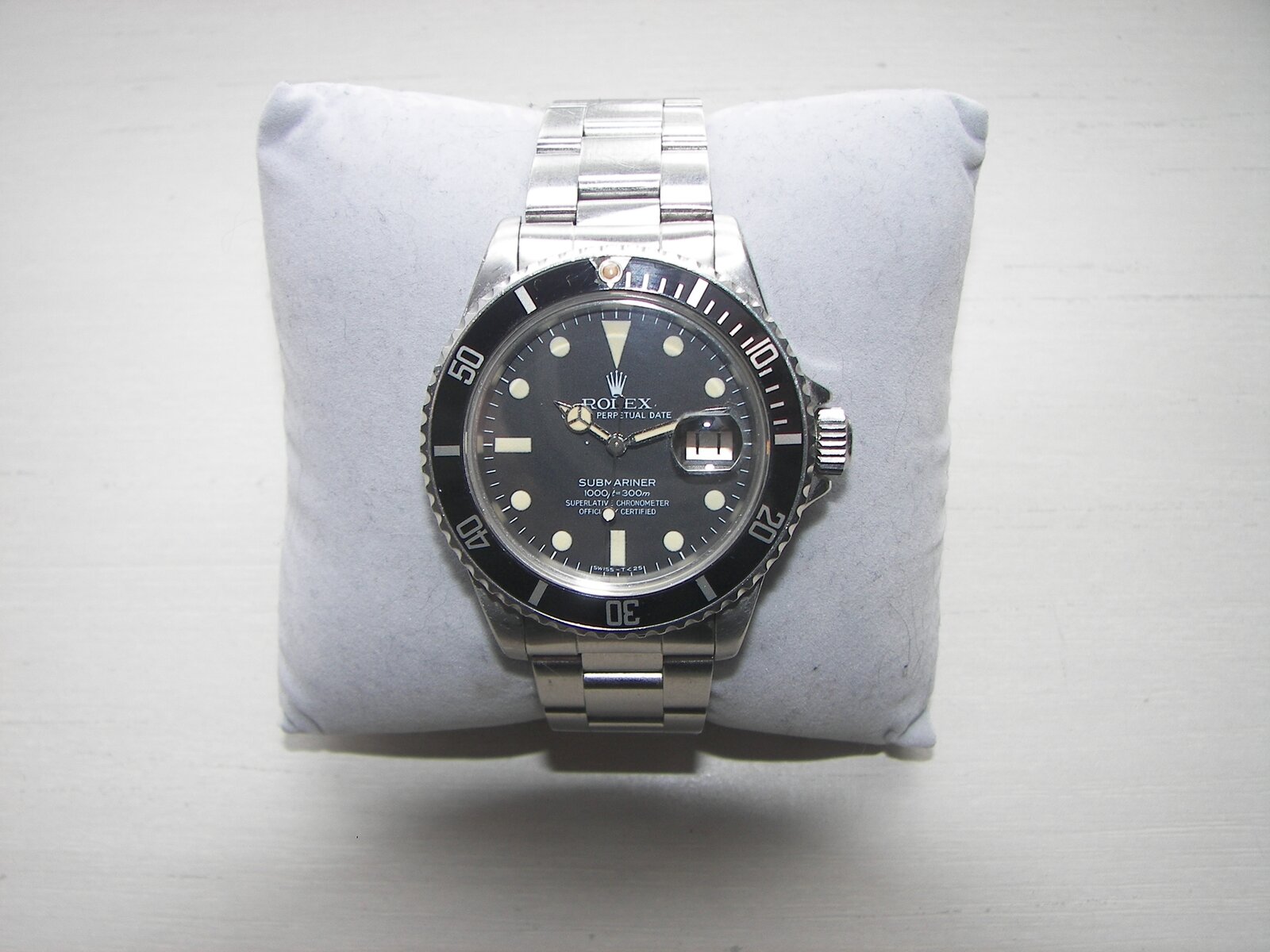
The Submariner: Built for Diving
The Submariner was introduced in the 1950s as a genuine tool watch for divers, built around water resistance, a rotating timing bezel for tracking elapsed dive time, and high-contrast luminous markers for visibility underwater. It has stayed in continuous production since, evolving gradually in water resistance rating, bracelet design and movement while keeping its core visual identity remarkably stable across seven decades.
That stability is part of why it's become one of the most recognized watch silhouettes in the world, and why even small generational differences — bezel material, crown guard shape, bracelet clasp design — matter a great deal to collectors trying to place a specific watch's production era.
No-Date vs. Date Models
The Submariner has long been offered in two parallel versions: a "no-date" model with a clean, symmetrical dial, and a date model with a date window at 3 o'clock, magnified by the Cyclops lens. This isn't a matter of one superseding the other — both have run in production for decades, and the choice comes down to preference for the cleaner symmetrical face versus the added functionality.
Collectors sometimes favour the no-date specifically for its dial symmetry, which is worth knowing so you don't mistake it for a lesser or incomplete model — it's a deliberate variant, not a stripped-down version.
The no-date Submariner isn't a stripped-down version of the date model. Both are deliberate, parallel variants.
Our Authentication TeamAluminum vs. Ceramic Bezels
Older Submariner references use an aluminum bezel insert, which fades gradually and attractively with UV exposure over years — the "ghost bezel" fading some collectors specifically seek out. From the mid-2000s onward, Rolex transitioned newer references to a scratch-resistant, fade-proof ceramic bezel insert (marketed as "Cerachrom"), which keeps its colour saturation indefinitely rather than aging visibly.
Neither is objectively better; they represent different eras and different aesthetic preferences, and the bezel type is one of the fastest ways to place roughly when a given Submariner reference was produced.
The Daytona: Built for Racing
Introduced in the 1960s and named for the Daytona International Speedway, the Daytona is a chronograph (stopwatch-function) model built around a tachymeter bezel for calculating average speed over a measured distance — a genuinely motorsport-driven design brief, distinct from the Submariner's diving origin.
Early manual-wind Daytona references from the 1960s and 70s are now among the most collected vintage Rolex watches in existence, a status that took decades to build and wasn't how the model was regarded when new.
The "Panda Dial" and Why It's Prized
Among Daytona collectors, the "panda dial" — a white dial paired with black sub-dials (or the reverse, a black dial with white sub-dials, sometimes called "reverse panda") — is a specifically sought-after configuration, valued for the strong visual contrast that makes the chronograph sub-dials easier to read at a glance.
This is a genuinely useful term to know when discussing or researching Daytona references, since dial colour combination is one of the primary ways specific configurations are identified and discussed among collectors and specialists.