 Contact Client Services via Whatsapp


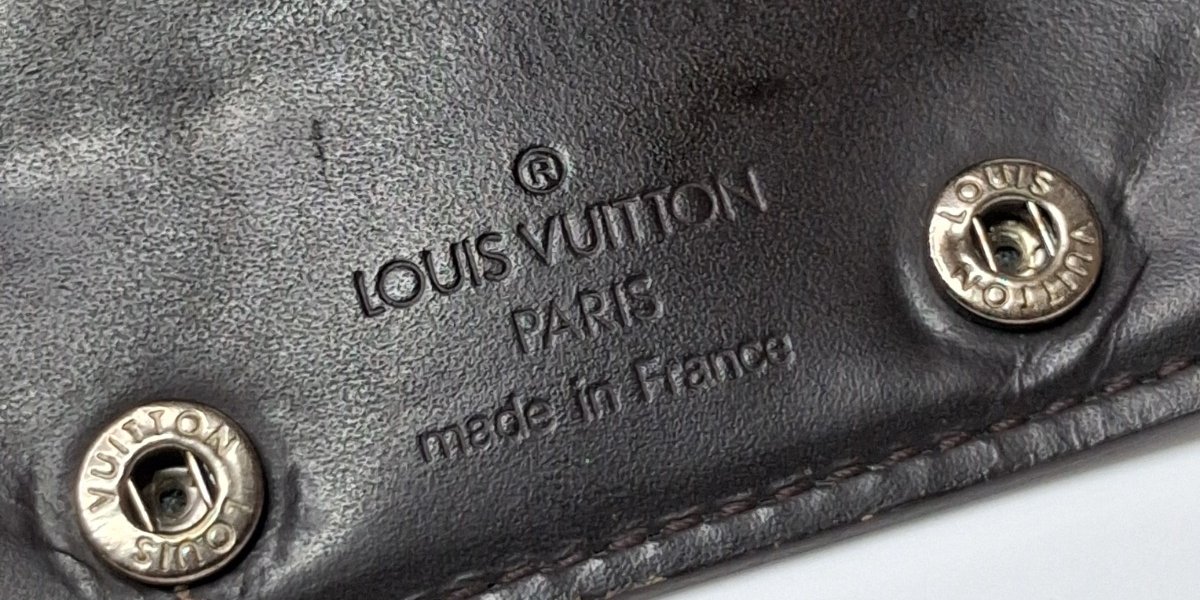
What a date code is — and what it isn’t
A Louis Vuitton date code is a short stamp recording where and roughly when a piece was made. It is not a serial number: every piece made in the same workshop in the same month (or week) carries the same code. And it is not a certificate of authenticity — counterfeiters copy correctly formatted codes as a matter of routine.
Think of it as a requirement, not proof. A genuine piece from the right era should have a code that reads correctly and matches the bag around it; a bag that passes the code test still has to pass every other test.
Where to find it
On handbags the code is usually heat-stamped on a small leather tab sewn into an interior seam, along the inside edge of a pocket, or directly on the lining near the top. On wallets and small leather goods it often sits beneath a card slot or inside the coin compartment.
It should be stamped in the same font, depth and colour as the bag’s other interior stamps. On well-used pieces it can be faint or partly worn away — a worn code is common; a code that looks newer than the bag around it is not.
Decode your code
Type the code from your piece to see where and when it was made. The tables below explain how each era is read.
| Era | Format | Example | How to read it |
|---|---|---|---|
| Early 1980s | 3–4 digits | 834 | Year first, then month: 83 + 4 → April 1983 |
| Late 1980s | Digits plus two factory letters | 8611 TH | 86 = 1986, 11 = November, TH = factory. The letters can appear before or after the digits |
| 1990 – 2006 | Two letters + four digits | SP0994 | Month = 1st and 3rd digits (0, 9 → 09); year = 2nd and 4th (9, 4 → 94): September 1994 |
| 2007 – early 2021 | Two letters + four digits | SR3179 | Week = 1st and 3rd digits (3, 7 → week 37); year = 2nd and 4th (1, 9 → 2019) |
| Spring 2021 onward | No visible code | — | Replaced by an embedded microchip that only Louis Vuitton can read |
Reading the digits, step by step
From 1990 onward the four digits are interleaved: split them into the first and third, and the second and fourth. Before 2007 the first pair is the month; from 2007 it is the week of the year. The second pair is always the year.
Run three sanity checks. First, the values must be possible: months run 01–12 and weeks 01–53, so “month 13” or “week 60” cannot exist. Second, the year must fit the piece: a model, canvas or colourway introduced in 2010 cannot carry a 1999 code. Third, the format must fit the year — a week-style reading on a bag that only makes sense as 1995 points to a code that was copied without being understood.
A date code tells you when and where a piece claims to have been made. Whether it really was is a separate question.
The Fallen Archive Authentication Team| Country | Commonly cited factory letters |
|---|---|
| France | AR, AS, BA, BJ, CT, DU, ET, MB, MI, NO, RA, RI, SL, SN, SP, SR, TH, VI |
| France or USA | FL, SD (used by workshops in both countries) |
| USA | FC, FH, LA, OS, TX |
| Spain | CA, GI, LB, LM, LO, LW, UB |
| Italy | BO, CE, FO, MA, RC, RE, SA, TD |
| Germany | LP |
| Switzerland | DI, FA |
After 2021: microchips instead of codes
Factory lists like the one above are compiled by the resale trade — Louis Vuitton has never published one — so a code you can’t find on a list is a reason to look harder, not an automatic fail. The “Made in” stamp should agree with the country the letters point to.
From around March 2021 Louis Vuitton stopped heat-stamping date codes and began embedding small microchips in its leather goods. The chip can only be read by Louis Vuitton, so it is not a tool for buyers. Two things follow: a recent piece with no date code is normal, and a piece described as made in 2022 or later that shows a stamped code deserves careful questions.
- Format matches the era of the model and canvas
- Values are possible: month 01–12 (1990–2006) or week 01–53 (2007–2021)
- Factory letters agree with the “Made in” stamp
- Font, depth and colour match the bag’s other heat stamps
- A code dated before the model or canvas existed
- Impossible values such as month 13 or week 60
- A stamped code on a piece described as 2022 or later
- A code that is printed, sticker-applied or sharper than the worn bag around it
Frequently asked questions
No. There is no public database, and because thousands of pieces share each code, a code only helps you date a piece and check that its story is consistent.
Not necessarily. Pieces made after early 2021 have none, some older items never had one, and codes on well-loved bags wear away. Judge the bag on its other details.
No — at most the week (2007–2021) or the month (1990–2006), plus the workshop.